FracEvent: Event-Camera Simulation via Fractional-Relaxation Pixel Dynamics
An event camera simulator that keeps pixel-level voltage memory and localizes ON/OFF threshold crossings inside frame intervals.
1The University of Sydney · 2Massachusetts Institute of Technology · 3Beijing Technology and Business University
 arXiv
arXiv
Abstract
Simulating events by modeling the pixel lifecycle.
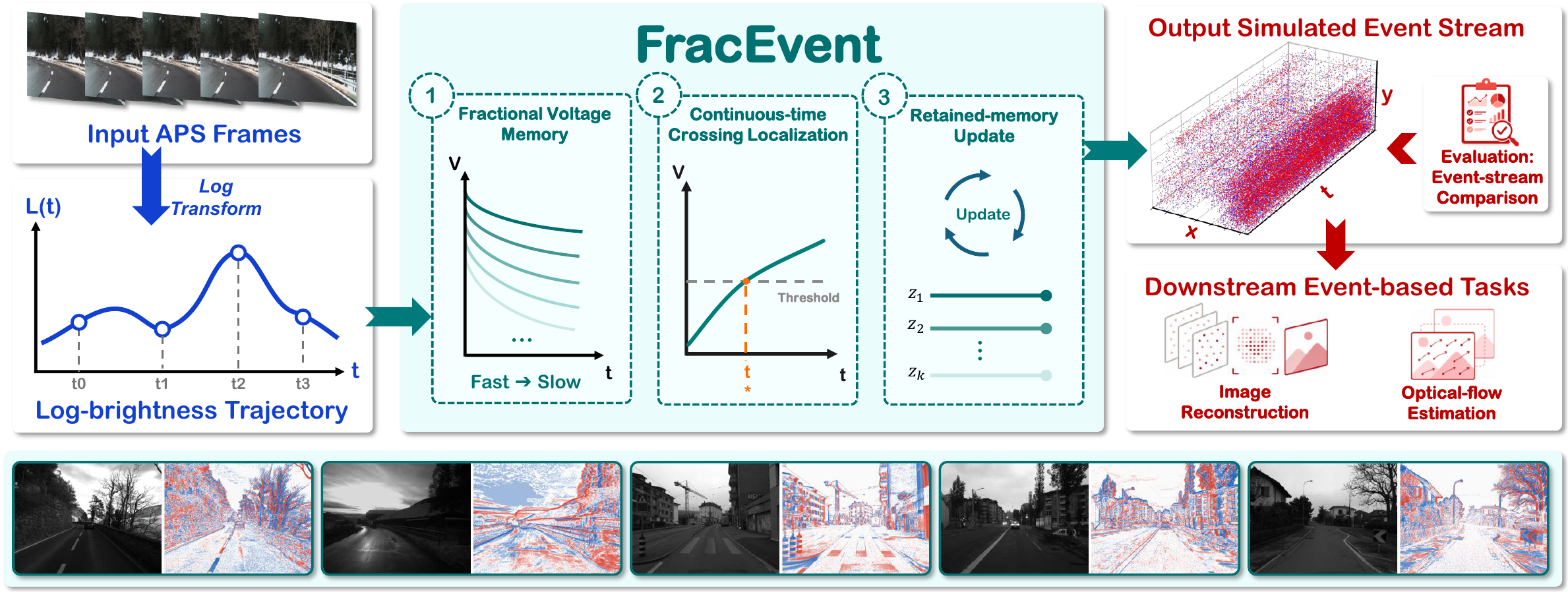
Event cameras asynchronously report brightness changes with microsecond-level temporal resolution, but real event data remain difficult to collect at scale because specialized sensors, careful synchronization, and task-specific annotations are required.
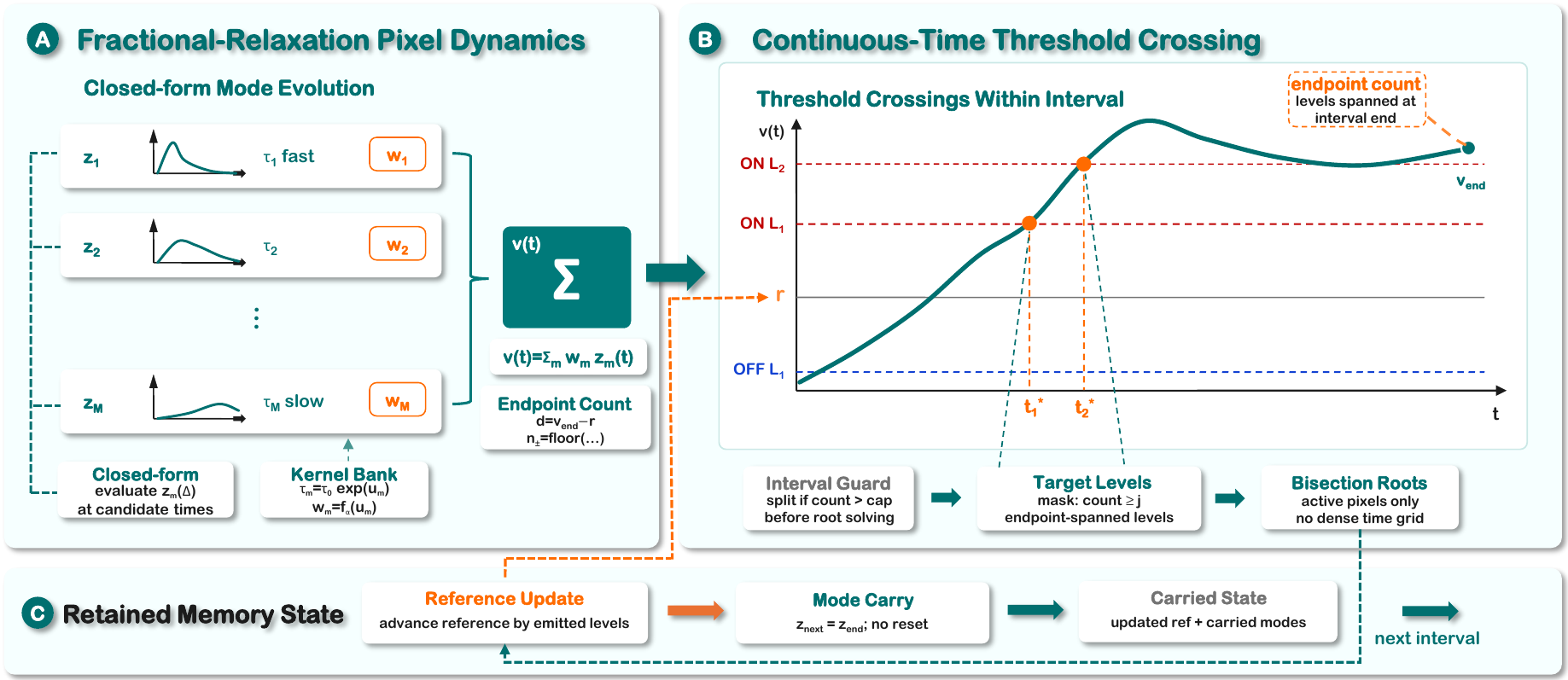
FracEvent models this pixel-level lifecycle with fractional-relaxation voltage dynamics. Given a log-intensity trajectory, it drives a compact stack of relaxation modes, combines their responses into a voltage state, emits ON/OFF events by localizing threshold crossings on the continuous voltage trajectory, and updates the reference while retaining the underlying memory modes.
The retained state links residual voltage response to later event timing. We evaluate FracEvent through direct event-stream comparison and downstream transfer on image reconstruction and optical flow estimation.
Method
Fractional memory, continuous crossing, retained state.
Each pixel keeps a finite stack of relaxation modes instead of treating frame differences as isolated contrast increments.
Events are localized on the voltage trajectory inside each frame interval, avoiding frame-boundary-only emission.
Event references update after threshold crossings, while the relaxation modes are carried into the next interval.
Frames provide the continuous interval endpoints used by the simulator.
Weighted relaxation channels approximate broad temporal memory.
Active pixels are solved for ON/OFF crossing times within the interval.
References advance by emitted levels while mode state remains available.
Results
Visualization and evaluation results.
Visualization
Eval result
On matched DAVIS240C windows, FracEvent achieves the lowest IEI distance and polarity error among the compared simulators.
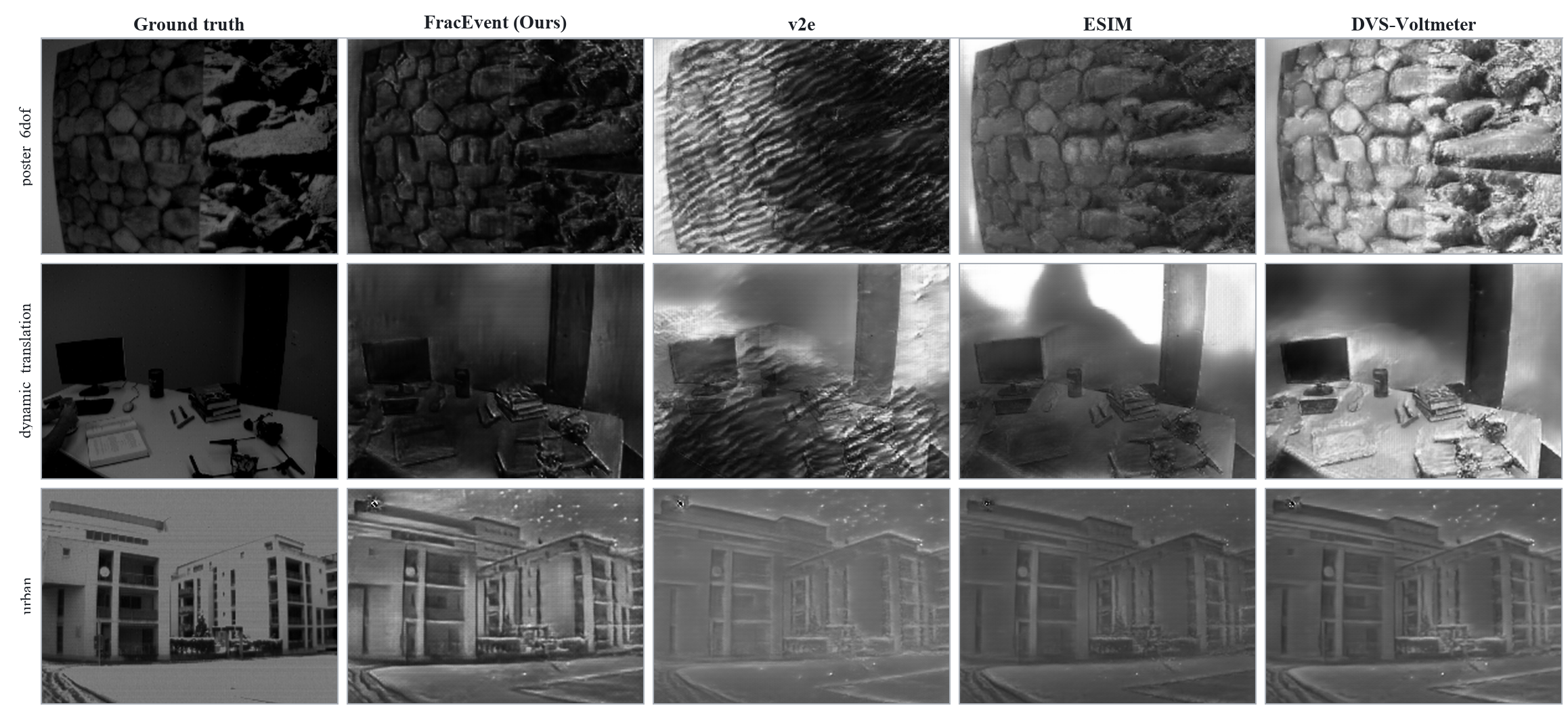
With the fixed E2VID-style training protocol, FracEvent gives the lowest DAVIS240C MSE (0.030) and LPIPS (0.460); ESIM has the highest DAVIS240C SSIM.
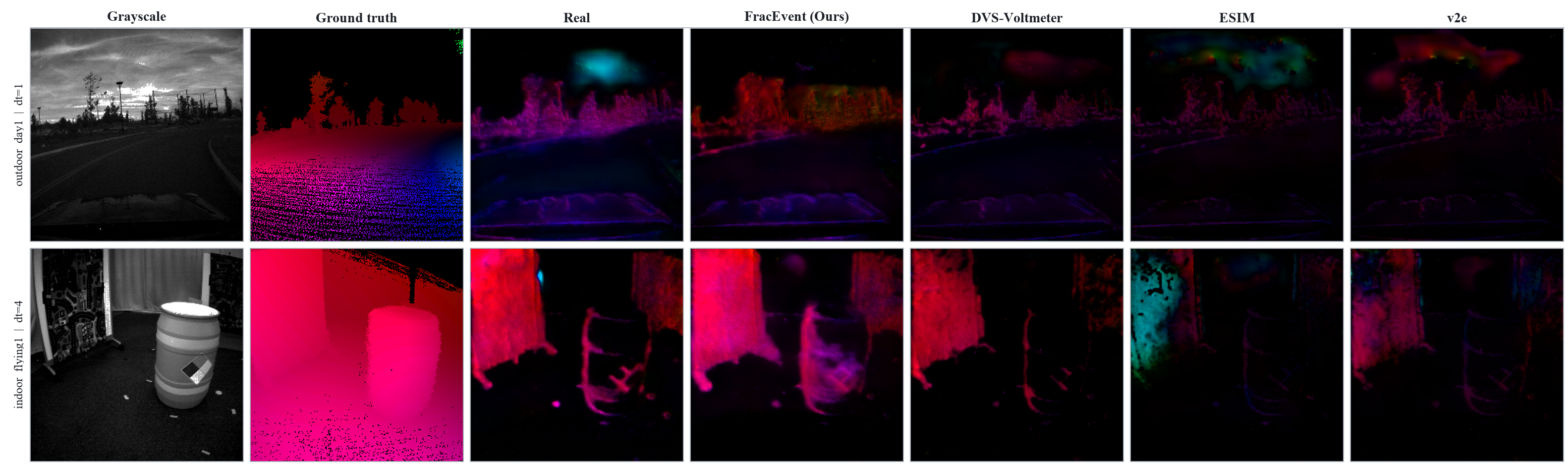
For EV-FlowNet-style training, FracEvent reaches 2.68 mean AEE, the lowest among simulated training sources and closest to training with real MVSEC events at 2.42.
Citation
Cite FracEvent.
@misc{chen2026fracevent,
      title={FracEvent: Event-Camera Simulation via Fractional-Relaxation Pixel Dynamics},
      author={Langyi Chen and Chuanzhi Xu and Haoxian Zhou and Pengfei Ye and Ziyu Luo and Haodong Chen and Qiang Qu and Xiaoming Chen and Weidong Cai},
      year={2026},
      eprint={2606.26636},
      archivePrefix={arXiv},
      primaryClass={cs.CV},
      url={https://arxiv.org/abs/2606.26636},
}